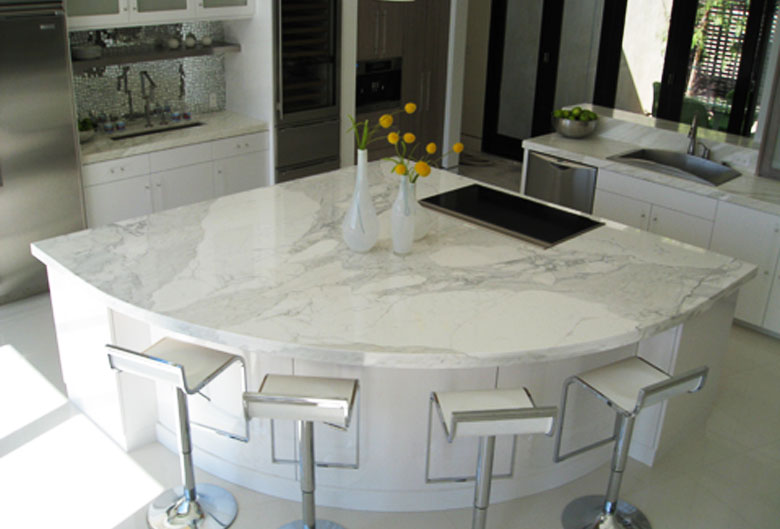
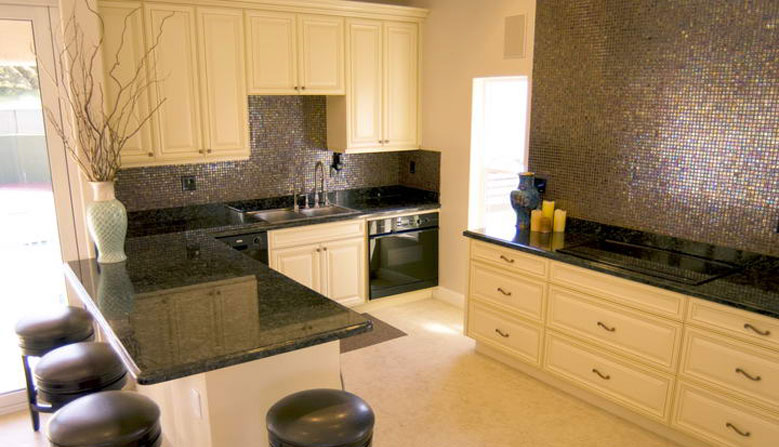
Granite, and granite-like materials, are capable of taking a wide variety of finishes which allow the designer to custom-tailor the stone to the aesthetic or performance requirements of a specific application

The dimensional stability of granite is very good, so good in fact, that granite is the material of choice for high precision applications such as surface plates, machine mounts and press rolls, where tolerances can be measured in micro-inches (millionths of an inch).


We specialize in marble, granite, limestone and CaesarStone®. We are an authorized dealer and fabricator of CaesarStone products.

CaesarStone Authorized Dealer CaesarStone Authorized Fabricator


December 12 2005

“I would like to thank you both for the amazing job you did in my new house. It was my pleasure to do business with your company.”
- Lisa Ben

“We are so pleased with the design of our new kitchen. It is more open and functional. It is just what we hoped it would be. Thanks so much!”
- Eve Bahar

view all


Granite Facts

What is granite?

Granite is a tough, durable rock composed primarily of three different minerals. These minerals are easy to see due to their different colors. The white mineral grains found in granite are feldspar. It is the most abundant mineral found in granite. The light gray, glass-like grains are quartz, and the black, flake-like grains are biotite or black mica.

Granite and marble. How are they different? 
Marble is simply limestone that has been compressed and/or heated deep within the earth's crust. Unlike granite, marble was never molten rock, but it may have been heated and squeezed enough for the limestone grains to bend and flow. Marble is also made up of only one mineral -- calcite -- a relatively soft mineral with a hardness of "3". Calcite is a common mineral -- all limestones and nearly all seashells are made of it, but it does not occur in granite. Because marble is made entirely of calcite, it is much softer than granite.


Monumental Stone

Characteristics
Not all granites are classified by the U.S. Bureau of Mines as suitable for "monumental stone." According to the Bureau's standards for "Class 1" granites, they must meet exacting requirements such as uniform texture and color, freedom from flaws and general suitability for polishing and carving as well as resistance to weathering. Elberton blue-gray granites meet these requirements in every respect.

view all